The days of running influencer campaigns on Instagram alone are over. TikTok grew attention by 18% year-over-year while Instagram declined 14%. YouTube continues to gain ground through Shorts. Gen Z is migrating to closed communities on Discord, Patreon, and Substack. Creators aren’t on one platform anymore – they’re spread across all of them.
For brands, this fragmentation creates a practical problem: the influencer marketing platform you chose two years ago might only search two or three social networks. That was fine when Instagram was the center of gravity. In 2026, if your tool can’t discover creators on TikTok, YouTube, Pinterest, and emerging platforms with the same depth it covers Instagram, you’re missing the majority of the creator landscape.
Upfluence covers seven platforms, but its 12M profile database limits how many creators you’ll actually find on each one. If your influencer strategy has expanded beyond Instagram – or needs to – this guide evaluates 10 alternatives based on how well they support multi-platform discovery, tracking, and campaign execution.
Here are the 10 platforms we’ll compare:
- Influencer Hero
- GRIN
- Modash
- CreatorIQ
- Aspire
- Storyclash
- HypeAuditor
- Meltwater
- Later
- Heepsy
Why Multi-Platform Brands Are Leaving Upfluence in 2026
Upfluence supports seven social platforms, but several structural issues limit its effectiveness for brands running multi-platform creator programs:
- Small Database Across Many Platforms: Upfluence indexes 12M+ profiles spread across seven networks. Competitors index 200M-450M+ profiles – meaning for any given platform, Upfluence surfaces a fraction of the available creators.
- Limited Discovery Filters: Only 12 search filters make it difficult to find platform-specific creator types. When you’re searching for TikTok creators with specific audience demographics and content styles, fewer filters mean more manual sorting.
- Mandatory Annual Contracts: Plans start at $24,000+ per year for two seats with no free trial. As brands experiment with new platforms like YouTube Shorts or Twitch, locking into a tool that may not support those workflows well is a risky bet.
- No Self-Service Evaluation: You can’t test the platform’s multi-platform capabilities before committing. For teams expanding to new social networks, this creates unnecessary friction.
Best Multi-Platform Upfluence Alternatives in 2026
1. Influencer Hero
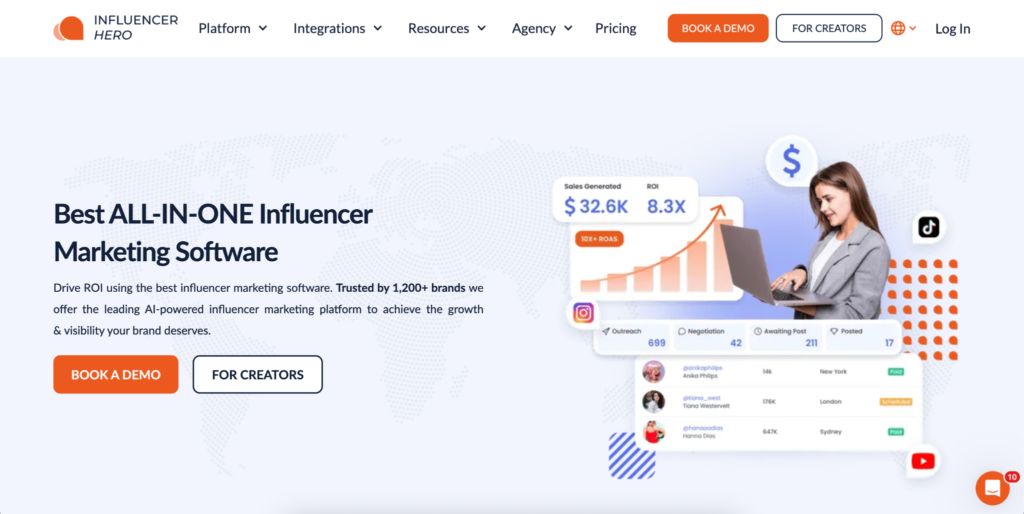
Influencer Hero offers the widest platform coverage on this list – searching across eight social networks from a single dashboard. With 450M+ creator profiles spanning Instagram, TikTok, YouTube, Pinterest, Snapchat, Twitch, and X, it’s built for brands that need to find and manage creators wherever they’re active, not just on one or two platforms.
Best for: Brands running influencer programs across multiple social platforms that need unified discovery, outreach, and tracking from a single system.
Pricing:
- Standard: $649/month (1 seat, up to 1,000 creators, 1,000 outreach/mo)
- Pro: $1,049/month (3 seats, up to 5,000 creators, 5,000 outreach/mo)
- Business: $2,490/month (8 seats, up to 10,000 creators, 10,000 outreach/mo)
- Custom & Agency plans available with unlimited outreach
Standout features:
- 450M+ Creators Across 8 Platforms: Instagram, TikTok, YouTube, Pinterest, Snapchat, Twitch, and X – all searchable with audience quality scoring, demographic filters, and lookalike recommendations.
- AI-Powered Outreach (43% Response Rate): Automated drip campaigns with AI-personalized first lines tailored to each creator’s platform-specific content. Works the same whether you’re contacting a TikTok creator or a YouTube creator.
- CRM With Automation Engine: Campaign boards, deal pages, conversation history, and rules-based triggers. Manage creators from multiple platforms in one unified pipeline.
- Five eCommerce Integrations: Shopify, WooCommerce, Magento, BigCommerce, and Prestashop for product gifting, affiliate tracking, and per-creator revenue attribution regardless of which platform the creator uses.
- Creator Storefronts (Up to 8x ROI): Branded storefronts where creators sell your products with affiliate commissions – a revenue channel that works independently of any single social platform.
- Fraud Detection: Audience authenticity analysis across all supported platforms.
The platform’s comprehensive feature set means there’s a learning curve for teams new to influencer software. Brands running only a few campaigns per year may not leverage every capability, though the multi-platform architecture ensures you won’t need to switch tools as you expand to new networks.
2. GRIN
GRIN is an enterprise-grade platform built for eCommerce and DTC brands that need unlimited creator partnerships. While its strength is Shopify integration and UGC management, it supports discovery across multiple platforms with its Gia AI assistant for creator matching.
Best for: Established DTC brands with enterprise budgets that prioritize Shopify integration and unlimited creator capacity.
Pricing:
- Custom; entry tier typically starts around $2,500/month
- 12-month minimum commitment
- Annual cost typically $25,000+/year
Standout features:
- Unlimited Creator Partnerships: No caps on influencer count – built for high-volume seeding across platforms.
- AI Discovery (Gia): Intelligent assistant for surfacing creators that match brand criteria across social networks.
- Creator Portals: Private dashboards where creators access briefs, submit content, and track earnings.
- Automatic Media Rights: Content reuse rights built into the booking flow regardless of source platform.
- UGC Library: Searchable repository including Stories for cross-channel content repurposing.
GRIN doesn’t publish its database size, making it difficult to assess how deep its coverage runs on each platform. The $25,000+/year commitment and 12-month minimum create the same lock-in that pushes many brands away from Upfluence. Brands expanding to newer platforms should verify coverage depth before committing.
3. Modash
Modash indexes 350M+ public creator profiles and pairs that massive database with AI visual discovery – upload an image or describe a style and the platform finds matching creators. Its Shopify-native affiliate workflows make it particularly strong for eCommerce brands expanding their creator reach across platforms.
Best for: Shopify-based brands that want broad, multi-platform discovery powered by one of the largest creator databases available.
Pricing:
- Essentials: $199/month
- Performance: $499/month
- Enterprise: Custom (annual billing)
Standout features:
- 350M+ Public Creator Database: Non-opt-in profiles across multiple platforms give you massive discovery breadth.
- AI Visual Discovery: Describe an aesthetic or upload a reference image to find creators with matching content across platforms.
- Shopify-Native Gifting & Affiliates: Automated discount codes, UTM tracking, and product selection from your catalog.
- Built-In Outreach & CRM: Bulk email with Gmail/Outlook sync and centralized relationship management.
- Fake Follower Detection: Audience authenticity scoring to verify creator quality across platforms.
Modash’s deep eCommerce integrations only work with Shopify – brands on other platforms are limited. It also lacks native content licensing and AI-powered outreach personalization. The database breadth is excellent, but brands needing full-workflow automation across platforms will find gaps compared to all-in-one solutions.
4. CreatorIQ
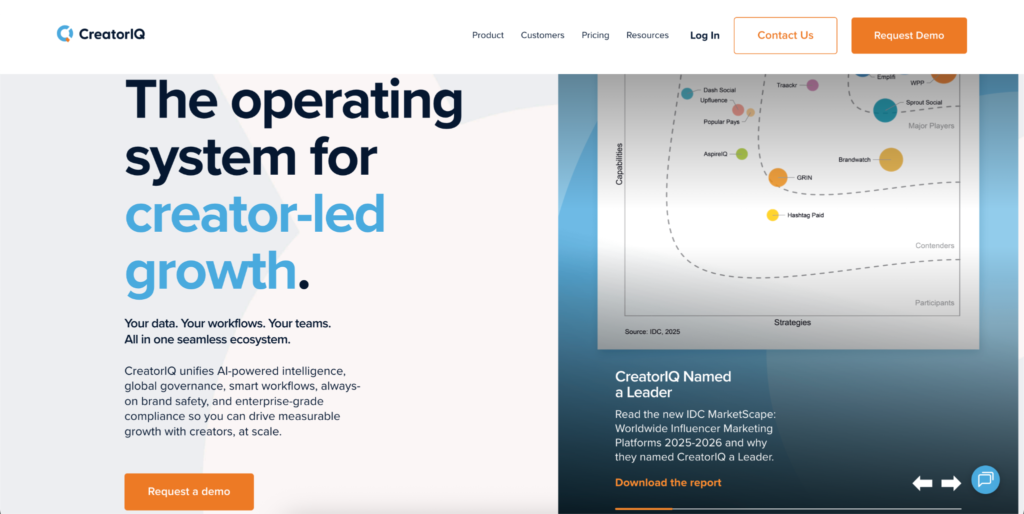
CreatorIQ serves the enterprise tier – Fortune 500 brands running global influencer programs that span multiple platforms, regions, and compliance requirements. Its direct API integrations with social platforms provide real-time data that’s particularly valuable for brands tracking performance across networks simultaneously.
Best for: Large enterprises managing multi-platform, multi-region creator programs with complex governance and compliance needs.
Pricing:
- Starts at $35,000/year
- Enterprise plans up to $200,000/year
Standout features:
- Enterprise-Grade Reporting: Live dashboards with direct API integrations to social platforms for real-time, cross-platform performance data.
- Advanced CRM & One-Sheets: Streamlined creator review across platforms for multi-stakeholder organizations.
- UGC Rights Management: Request, track, and manage content usage rights across campaigns, platforms, and regions.
- Global Creator Coverage: Strong international data spanning multiple social networks and languages.
- Payment Compliance: Built-in tax documentation and multi-currency payouts for creators across platforms.
At $35,000-$200,000 per year, CreatorIQ is priced for organizations with dedicated influencer departments. Its multi-platform capabilities are strong, but the cost means only the largest brands can justify the investment. Brands that need similar cross-platform CRM depth and AI automation at a more accessible price point should compare alternatives like Influencer Hero carefully.
5. Aspire
Aspire differentiates with its inbound creator marketplace and first-party social data. Over a million creators actively apply to campaigns, and direct API integrations with Meta, TikTok, and Pinterest provide accurate audience insights across those platforms – not scraped estimates.
Best for: Mid-market brands with enough recognition to attract inbound creator interest across multiple platforms.
Pricing:
- Custom; mid-tier packages quoted around $2,300/month
Standout features:
- Inbound Creator Marketplace: 1M+ creators applying to campaigns across platforms – less outbound searching, more selecting.
- First-Party Social Data: Direct API integrations with Meta, TikTok, and Pinterest for reliable cross-platform audience insights.
- End-to-End Campaign Workflow: Discovery, contracts, content approvals, and tracking in one pipeline regardless of platform.
- Shopify Fulfillment: Creators select products from your catalog for seeding campaigns.
- Dedicated Client Support: Strategic onboarding and guidance included.
First-party data integrations cover Meta, TikTok, and Pinterest – strong but not exhaustive. Brands active on YouTube, Twitch, or Snapchat may find gaps. Custom pricing at ~$2,300/month limits cost transparency, and the inbound model works best for recognized brands. Lesser-known brands still need outbound discovery, where platforms with 350M-450M+ databases provide broader reach.
6. Storyclash
Storyclash focuses on content performance analytics and competitive intelligence across Instagram, TikTok, and YouTube. Its ability to capture expired Stories and analyze historical content gives brands a deeper view of how creators perform on each platform over time, not just based on current posts.
Best for: Brands that want content-driven creator selection and competitive benchmarking across Instagram, TikTok, and YouTube.
Pricing:
- Business plan starts at $870/month
- Enterprise plans available
Standout features:
- AI-Driven Discovery: Image recognition, natural language prompts, and lookalike search across 183M creator profiles on Instagram, TikTok, and YouTube.
- Historical Content Data: Access expired Stories and past content performance – see how creators have performed over time across platforms.
- Competitive Benchmarking: Track which creators competitors hired on each platform and how that content performed.
- Campaign Hub: Centralized collaboration tools for managing active campaigns across networks.
- Shopify ROAS Tracking: Measure return on ad spend, CAC, and AOV per creator regardless of which platform drove the traffic.
Storyclash covers three platforms (Instagram, TikTok, YouTube) – good coverage for the biggest networks but missing Pinterest, Snapchat, Twitch, and emerging channels. Its 183M database is solid but smaller than competitors indexing 350M-450M+. It lacks built-in contract generation and content licensing workflows.
7. HypeAuditor
HypeAuditor is the gold standard for influencer auditing and fraud detection. Its analytics go deep – audience authenticity scoring, engagement quality analysis, and follower growth patterns – across multiple platforms. For brands expanding to new networks, being able to verify creator quality on each platform before committing budget is essential.
Best for: Brands that need rigorous audience verification across platforms before committing to creator partnerships.
Pricing:
- Business plans start around $10,000/year
- Enterprise plans up to $60,000/year
Standout features:
- Advanced Fraud Detection: Industry-leading audience authenticity analysis across social platforms – essential when expanding to networks where you have less experience evaluating creators.
- AI Discovery & Lookalike Search: Find creators similar to your best performers on any platform by analyzing captions and visual content.
- Social Listening: Monitor hashtags, brand mentions, and competitor activity across platforms to identify organic advocates.
- Shopify Revenue Attribution: Track per-creator revenue through affiliate links regardless of which platform drove the conversion.
- Creator Application Pages: Custom landing pages for cross-platform creator recruitment.
HypeAuditor excels at analytics but doesn’t handle campaign execution. No AI-powered outreach, no CRM automation, no product gifting. Brands need additional tools for the rest of the workflow – adding complexity and cost. All-in-one platforms with built-in fraud detection cover both verification and execution in one subscription.
8. Meltwater
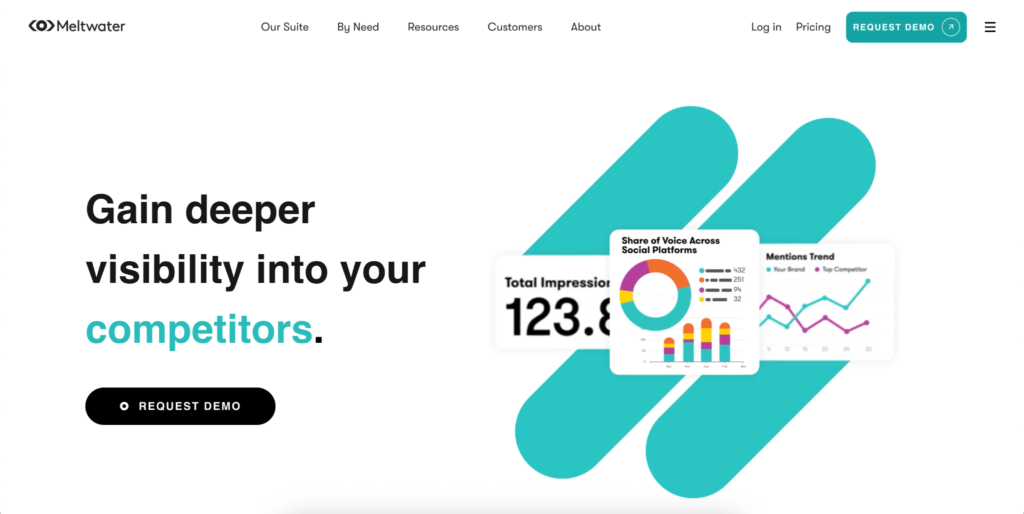
Meltwater integrates influencer marketing with media monitoring and social listening through its Klear platform. Its Visual AI search finds creators by image and content themes across platforms, and its True Reach technology estimates real audience impact beyond raw follower numbers.
Best for: PR and communications teams that want cross-platform influencer marketing integrated into their media intelligence stack.
Pricing:
- Klear influencer plans start around $33,100/year (discounted)
- Standard pricing from $50,000+/year
Standout features:
- True Reach Technology: AI estimates real audience reach across platforms by analyzing engagement patterns and audience overlap.
- Visual AI Search: Find creators by uploading images or describing visual themes – works across platform boundaries.
- Integrated Chat & Payments: Message creators and process payments in-platform.
- Audience Sentiment Analysis: Track how audiences respond to creator content across different social networks.
- Cross-Channel Reporting: Unified dashboards combining influencer data with earned media and PR metrics.
Meltwater’s 30M influencer database is significantly smaller than competitors indexing 200M-450M+ profiles – which limits how many platform-specific creators you’ll find. At $33,000-$50,000+/year, the pricing only makes sense if you’re using the full media monitoring suite. Most brands focused purely on multi-platform influencer marketing will find better value in dedicated platforms.
9. Later
Later layers influencer marketing onto its social media scheduling platform. The integration means creator content can be aligned with your organic posting calendar across networks – a workflow advantage for teams managing both paid and organic social from one place.
Best for: Social-first brands already using Later for multi-platform scheduling that want to add influencer capabilities without a separate tool.
Pricing:
- Self-serve influencer marketing plans start at approximately $28,500/year
- Pro and full-service options reach $50,000-$60,000/year
Standout features:
- 15M Contactable Creators: Verified email addresses for direct outreach across platforms.
- Cross-Platform Content Calendar: Plan influencer content alongside organic posts across all your social channels.
- Creator Application Pages: Custom pages for multi-platform creator recruitment.
- Shopify Gifting & Discounts: Discount code generation and product seeding with inventory tracking.
- Brand Safety Scanning: AI flags potential issues in creator content history across platforms.
Later’s 15M contactable creator database is small compared to platforms indexing 200M-450M+ profiles. At $28,500+/year for influencer plans, it’s enterprise pricing for what many brands find are mid-tier multi-platform capabilities. The unique value – managed services, advanced analytics – requires $50,000+ tiers. Lacks AI outreach automation and deep CRM functionality.
10. Heepsy
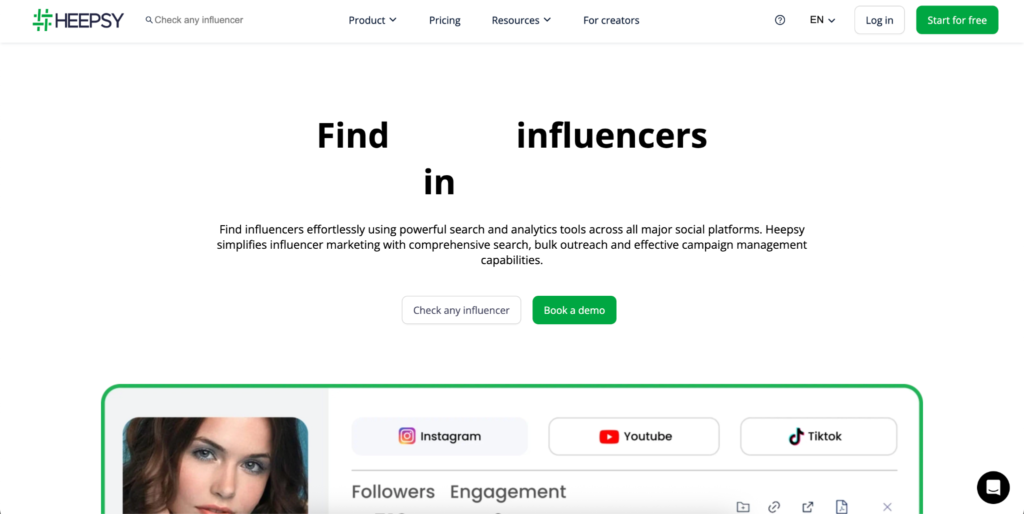
Heepsy provides an accessible starting point for multi-platform discovery. Its 50M+ database covers US and European markets across key social networks, and the free plan lets brands explore multi-platform search before committing any budget.
Best for: Early-stage brands testing multi-platform influencer campaigns that need affordable discovery and outreach to prove the channel works.
Pricing:
- Free plan available
- Starter: $89/month
- Plus: $249/month
- Advanced: $369/month (required for Shopify sales tracking)
Standout features:
- 50M+ Influencer Database: Multi-platform coverage across US and European markets.
- Authenticity Filters: Fake follower detection and audience quality scoring across platforms.
- Kanban-Style CRM: Visual pipeline for tracking creators from multiple platforms through campaign stages.
- Bulk Email Outreach: Up to 3,000 emails per month with follow-up sequences.
- Shopify & WooCommerce Tracking: Affiliate and discount code tracking on Advanced plans.
At 50M profiles, Heepsy’s multi-platform coverage is thinner than competitors indexing 200M-450M+. The best features require higher-priced plans, and outreach lacks AI personalization. A solid starting point for proving the channel across platforms, but brands scaling beyond 50 active partnerships will need the database depth and automation of a full-suite platform.
Final Thoughts
As creators spread across more platforms, the influencer marketing tools you use need to keep pace. Here’s how the platforms on this list stack up for multi-platform programs:
- Widest platform coverage: Influencer Hero leads with 450M+ creators across 8 platforms and full-workflow automation. CreatorIQ offers strong multi-platform data for enterprises willing to invest $35,000+/year.
- Largest databases for broad discovery: Modash (350M+) and Storyclash (183M) provide wide nets for finding creators across networks. Both have accessible entry pricing compared to enterprise alternatives.
- Best for specific platform data: Aspire’s first-party integrations with Meta, TikTok, and Pinterest deliver the most accurate audience data for those three networks specifically.
- Best for verification across platforms: HypeAuditor’s fraud detection works across social networks – valuable when you’re expanding to platforms where you have less experience evaluating creators.
- Budget-friendly multi-platform start: Heepsy’s free plan lets you explore multi-platform discovery. Later combines scheduling and influencer campaigns for social-first teams.
Many influencer marketing agencies now manage creator programs across five or more platforms simultaneously. If building that multi-platform infrastructure in-house isn’t practical, working with an agency that already has the tools and processes in place can accelerate your cross-platform expansion.
The bottom line: your influencer platform should be able to find creators wherever your audience is – not just where they used to be. As attention continues to shift, the tools that cover the most ground will deliver the most value.
FAQs
1. How many social platforms should my influencer tool cover?
At minimum, look for Instagram, TikTok, and YouTube – these are the core three for most brands. If your audience skews younger or niche, platforms like Pinterest, Snapchat, Twitch, and X become important. Influencer Hero covers all eight, which provides the most future-proof coverage.
2. Which platform has the largest creator database?
Influencer Hero indexes 450M+ profiles across 8 platforms. Modash follows with 350M+, Storyclash offers 183M, and Heepsy has 50M+. Upfluence’s 12M is the smallest among major competitors.
3. Does database size matter for multi-platform discovery?
Yes – significantly. A 12M database spread across seven platforms means roughly 1.7M profiles per network. A 450M database across eight platforms means 56M+ per network on average. That difference determines whether you find 5 relevant creators or 500 for any given search.
4. Should I use different tools for different platforms?
Generally no. Using separate tools for Instagram, TikTok, and YouTube creates data silos and prevents you from comparing cross-platform performance. A single all-in-one platform that covers all your target networks keeps everything in one place.
5. How do I track ROI across multiple platforms?
Use a platform with unified affiliate tracking and revenue attribution. Influencer Hero, Modash, and Storyclash all offer Shopify integrations that track per-creator revenue regardless of which social platform drove the traffic. The key is consistent tracking codes across all platforms.
6. Is TikTok or Instagram more important for influencer marketing in 2026?
TikTok is growing (+18% YoY in attention) while Instagram is declining (-14% YoY). However, Instagram still has the largest established creator economy and the most mature commerce integrations. The smart play is to cover both – plus YouTube, which continues to grow steadily. The best platforms support all three without forcing you to choose.
Keywords: multi-platform influencer marketing tools, Upfluence alternatives multi-platform, best influencer marketing platforms 2026, cross-platform creator discovery, TikTok Instagram YouTube influencer tool, Influencer Hero vs Upfluence, influencer marketing platform comparison, multi-channel influencer software