Red team operations aim to test how well an organisation can detect and respond to real-world attacks. The goal is not noise or volume. It is realism. Tools play a critical role in this process, helping red teamers emulate threat behaviour across endpoints, networks, identities and cloud environments.
Despite constant innovation, many red team tools remain consistent. Some are commercial platforms built for controlled simulations. Others are open-source tools refined over years of community use. Each serves a specific purpose within an engagement.
This article focuses on red team tools professionals actually use. It highlights widely adopted red team security tools and explains where each fit within offensive operations. The emphasis remains on tooling rather than tactics or methodologies.
How red team tools are selected
Red team tools are chosen based on realism, reliability and control. Mature teams favour tools that mirror attacker behaviour without introducing unnecessary risk. Stability matters. So does flexibility.
Commercial red team security tools often provide management, reporting and safety controls. Open-source tools offer depth, customisation and transparency. Most engagements use a blend of both.
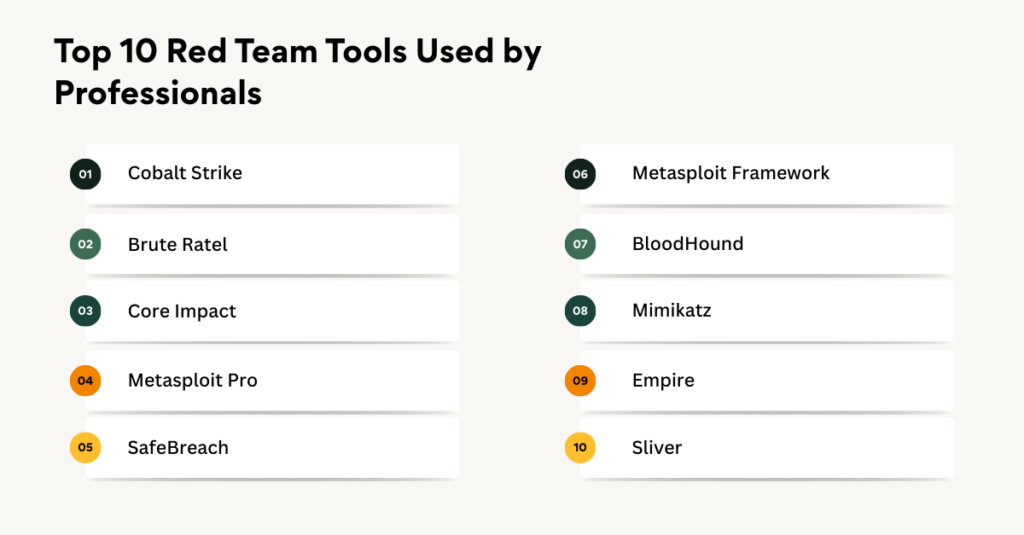
The sections below outline ten commonly used red team tools, split evenly between commercial and open-source options.
Commercial red team tools used by professionals
These are the top red team tools used by red teamers in our experience:
1. Cobalt Strike
Cobalt Strike remains one of the most widely recognised red team tools. It provides post-exploitation capabilities, command-and-control infrastructure and attack simulation features.
Its strength lies in flexibility. Beacon payloads can be customised to emulate different attacker behaviours. Mature teams value its ability to model lateral movement, privilege escalation and persistence in a controlled manner.
Cobalt Strike is often used in assumed-breach scenarios and full-scope red team exercises.
2. Brute Ratel
Brute Ratel is a newer commercial red team tool designed to address modern detection challenges. It focuses on evasive command-and-control techniques and advanced payload delivery.
The platform includes graphical tooling for payload generation and infrastructure management. Red teamers often use Brute Ratel when testing advanced endpoint detection and response capabilities.
Its design reflects how sophisticated attackers adapt to modern security controls.
3. Core Impact
Core Impact offers a broad offensive testing platform covering network, endpoint and application attack paths. It combines exploit modules with post-exploitation workflows and reporting.
Security teams often use Core Impact during structured red team engagements where repeatability and auditability matter. The platform supports complex attack chains without requiring extensive custom scripting.
It is commonly used in environments that require formal reporting and clear risk mapping.
4.Metasploit Pro
Metasploit Pro builds on the open-source Metasploit Framework with enterprise features. It adds automation, collaboration and reporting capabilities suited to professional red team operations.
The platform supports exploit development, payload management and post-exploitation workflows. It is frequently used to validate exposure and demonstrate impact during controlled engagements.
Metasploit Pro remains a staple among red team security tools for organisations that value structure.
5. SafeBreach
SafeBreach focuses on continuous breach and attack simulation rather than traditional manual red teaming. It provides a library of attacker techniques mapped to real-world threat behaviours.
Red teams use SafeBreach to validate detection coverage and control effectiveness over time. While less hands-on, it supports ongoing testing and helps identify gaps before full red team exercises.
It is often used alongside manual tooling rather than as a replacement.
Open-source red team tools used by professionals
There are many free tools available in the market. Here’s what makes the top 10 list:
6. Metasploit Framework
The Metasploit Framework is one of the most widely used open-source red team tools. It supports exploit development, payload generation and post-exploitation activities.
Its modular architecture allows red teamers to customise workflows and integrate new exploits quickly. Despite its age, it remains relevant due to constant community updates.
Many commercial tools build directly on its foundation.
7. BloodHound
BloodHound is used to analyse Active Directory attack paths. It visualises relationships between users, groups, permissions and systems.
Red teamers rely on BloodHound to identify privilege escalation paths that are difficult to spot manually. It excels during internal network assessments and identity-focused engagements.
Its graph-based approach makes complex environments easier to understand.
8. Mimikatz
Mimikatz is a credential access tool used to extract authentication material from Windows systems. It highlights weaknesses in credential handling and privilege separation.
Red teams use Mimikatz carefully and deliberately, often in controlled scenarios. Its impact is significant, which makes it effective for demonstrating risk to stakeholders.
Despite defensive advances, it remains relevant in many environments.
9. Empire
Empire is a post-exploitation framework that supports PowerShell and Python agents. It enables command execution, lateral movement and persistence.
Red teamers value Empire for its flexibility and scriptable nature. It integrates well with other tooling and supports custom module development.
It is often used in environments where PowerShell-based attacks remain viable.
10. Sliver
Sliver is a modern open-source command-and-control framework designed as an alternative to older tools. It supports cross-platform implants and modern encryption.
Red teamers use Sliver to test detection capabilities against newer tooling. Its active development and community support make it attractive for advanced engagements.
Sliver is commonly chosen when flexibility and modern protocols are required.
How red team tools are used together
Rarely does a red team rely on a single tool. Red team tools are combined based on engagement goals, target environment and defensive maturity.
An operation might begin with reconnaissance and access validation, move into post-exploitation and lateral movement, then finish with impact demonstration. Each phase may rely on different red team security tools.
Tool choice often reflects what defenders are likely to face in the real world. Familiar tools test baseline detection. Newer tools test adaptability.
Operational considerations when using red team tools
So, what are few considerations to keep in mind while operating red team tools? Find our below:
1. Safety and control
Professional red teams operate under strict rules of engagement. Tools must support safe execution and rapid shutdown if required. Commercial platforms often include built-in safeguards.
Open-source tools require greater discipline and experience. Clear scoping and testing reduce unintended disruption
2. Detection realism
The purpose of red team tools is not stealth for its own sake. It is realism. Tools should trigger alerts that mirror real attacker behaviour, not artificial noise.
Balanced use of well-known and less common tools provides a more accurate assessment of defensive readiness.
3. Reporting and evidence
Effective red team tools support evidence collection. Logs, screenshots and telemetry help demonstrate impact and support remediation planning.
Commercial tools often simplify reporting. Open-source tools require manual documentation but offer greater transparency.
Conclusion
Red team tools shape how effectively an organisation can test its security posture. Commercial platforms provide structure, safety and reporting. Open-source tools deliver flexibility, depth and realism.
Professional red teamers choose tools based on purpose, not popularity. Each tool supports a specific phase of an attack simulation. Used together, they provide a clearer picture of how defences perform under pressure.
Understanding commonly used red team tools helps security leaders interpret findings, prioritise improvements and strengthen detection and response capabilities over time.
CyberNX is a one of the leading, trusted and CERT-In empanelled cybersecurity firm offering advanced adversarial simulations. You can partner with firms like CyberNX to choose best red team tools and further boost the entire digital security of your organisation.