Linus Torvalds is the Finnish-American software engineer who created the Linux kernel in 1991 and the Git version control system in 2005, two tools that run most of the world’s servers, Android phones, supercomputers, cloud platforms and developer workflows. As of November 2026, Linus Torvalds net worth is widely estimated at around $50 million USD, which works out to roughly ₹440 crore at current exchange rates. When people search for Linus Torvalds net worth in rupees,
they are often surprised it is not in the thousands of crores, given how much of the global economy depends on his code. The reason is simple: he gave Linux away for free under an open-source license, and his wealth comes mainly from early stock grants, his long-running salaried role at the Linux Foundation, and book royalties rather than ownership of a company.
This profile covers Linus Torvalds net worth, his age, wife, children, religion, birthday, education, career timeline, awards, and his most recent work in 2026 as he continues to lead Linux kernel development at the age of 56.
Table of Contents
Linus Torvalds Quick Facts Summary
Before getting into the details, here is a quick overview of the most important facts about Linus Torvalds in 2026.
| Field | Details |
|---|---|
| Full Name | Linus Benedict Torvalds |
| Nickname | Linus, “Benevolent Dictator for Life” (BDFL) of Linux |
| Date of Birth | 28 December 1969 |
| Age | 56 years (turns 57 on 28 December 2026) |
| Birthplace | Helsinki, Finland |
| Nationality | Finnish-American (US citizen since 2010) |
| Zodiac Sign | Capricorn |
| Religion | No religion (non-religious, describes himself as uninterested in religion) |
| Marital Status | Married to Tove Torvalds since 1993 |
| Children | Three daughters (Patricia, Daniela, Celeste) |
| Known For | Creating the Linux kernel and Git |
| Net Worth | About $50 million (approx. ₹440 crore), estimate |
Personal Information
Linus Torvalds keeps a low public profile outside of his technical work, so some physical details below are approximate public estimates rather than confirmed figures.
| Attribute | Details |
|---|---|
| Full Legal Name | Linus Benedict Torvalds |
| Title | Creator and lead maintainer of the Linux kernel; Linux Foundation Fellow |
| Height | Approx. 5 ft 9 in (about 1.75–1.77 m), unverified estimate |
| Weight | Approx. 80–85 kg, unverified estimate |
| Eye Color | Blue |
| Hair Color | Light brown / dirty blond, now greying |
| Complexion | Fair |
| Distinguishing Features | Rimless or thin-framed glasses, relaxed Nordic look, frequent smile in interviews |
| Dress Style | Casual: T-shirts, polo shirts, jeans, sweaters; rarely seen in suits |
| Voice | Calm, soft-spoken Finnish-Swedish accent, famously blunt in writing |
Family & Personal Life Background
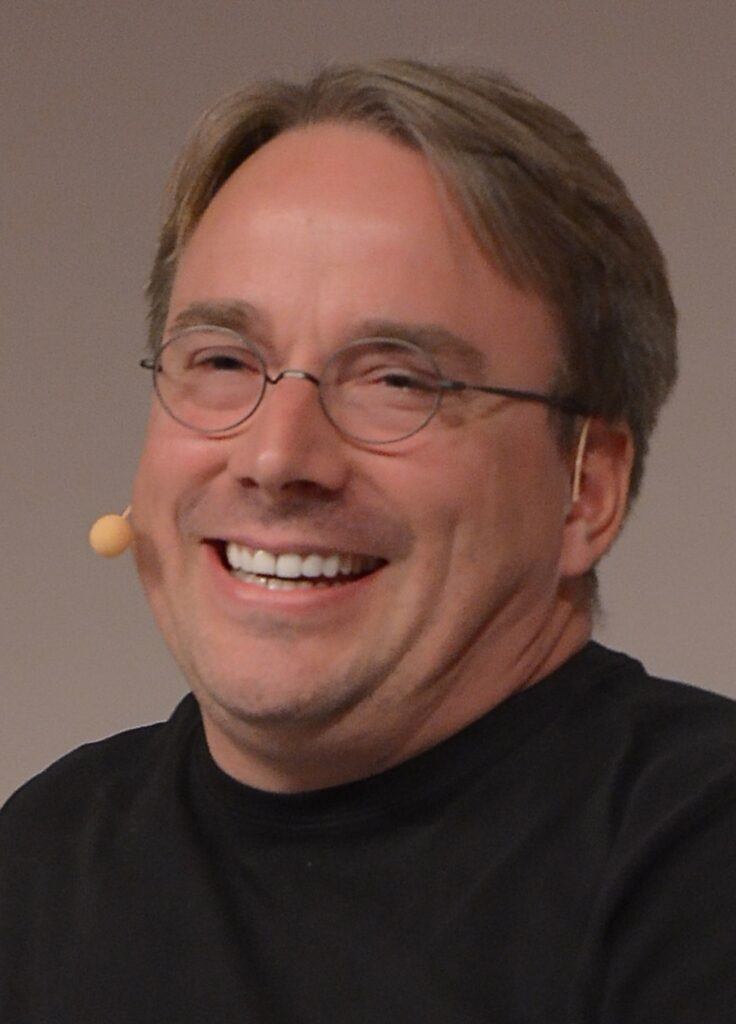
Linus Torvalds grew up in a family of journalists, writers and intellectuals, and that background shaped his independent, outspoken personality.
Family Heritage & Ancestry
Torvalds belongs to Finland’s Swedish-speaking minority, and his first language is Swedish. His parents were both journalists, and he was named after Nobel Prize–winning chemist Linus Pauling. The table below lists his close family members.
| Family Member | Relation | Details |
|---|---|---|
| Nils Torvalds | Father | Journalist and politician; served as a Member of the European Parliament for Finland |
| Anna Torvalds (Mikke) | Mother | Journalist and translator who worked at Finnish news organizations |
| Ole Torvalds | Paternal grandfather | Finnish poet and journalist |
| Leo Waldemar Törnqvist | Maternal grandfather | Statistician who gave young Linus access to his Commodore VIC-20 computer |
| Sara Torvalds | Sister | Translator and writer |
| Tove Torvalds (née Monni) | Wife | Six-time Finnish national karate champion; married Linus in 1993 |
| Patricia Miranda Torvalds | Daughter | Born 1996 |
| Daniela Yolanda Torvalds | Daughter | Born 1998 |
| Celeste Amanda Torvalds | Daughter | Born 2000 |
A common search is Linus Torvalds son, but he does not have a son. He and Tove have three daughters. Linus Torvalds’ wife Tove met him in 1993 when she was a student in a computer course he was assisting with at the University of Helsinki; she reportedly sent him an email asking him out, and they married soon afterward. The family moved to California in 1997 and later settled in the Portland, Oregon area, where they still live.
His parents divorced when he was young, and he was largely raised by his mother and grandparents. His grandfather’s computer is where his love for programming began, at around age 10 or 11.
Personal Life Philosophy
Linus Torvalds has always described himself as an engineer first and a public figure last. His autobiography is titled Just for Fun: The Story of an Accidental Revolutionary (2001), and that title captures his approach: Linux started as a hobby, not a business plan. He believes the best motivation for work is enjoyment and curiosity, followed by social connection, with money as a lower-order motivator once basic needs are met.
On religion, Torvalds has said he is not religious and does not find religion relevant to his life. On wealth, he has repeatedly said he is comfortable but never wanted to be a billionaire, and that being rich was never the point. He has also said he prefers working from his home office in a bathrobe to running a large company.
His other well-known principle is pragmatism over ideology. He supports open source because it produces better software, not because of a moral crusade. That practical attitude showed up again in 2026, when he publicly backed the use of AI coding tools in kernel development on technical grounds.
Educational Journey
Torvalds’ education combined formal schooling in Helsinki with intensive self-taught programming on home computers.
Schools & Early Education
His early years were spent in Helsinki, where he attended Swedish-language schools and taught himself programming on his grandfather’s machine before buying his own computer.
| Level | Institution | Location | Years | Achievements |
|---|---|---|---|---|
| Primary school | Swedish-language primary school | Helsinki, Finland | ~1976–1982 | Began programming in BASIC on a Commodore VIC-20 around age 10–11 |
| Secondary school | Swedish-language secondary school (lukio) | Helsinki, Finland | ~1982–1988 | Learned assembly language; bought a Sinclair QL and wrote his own tools and games |
| Military service | Finnish Navy, Uusimaa Brigade | Finland | 1989–1990 | Completed national service, reaching the rank of second lieutenant (ballistics/fire control role) |
University Education
Torvalds’ university years are where Linux was born, making the University of Helsinki one of the most important places in modern computing history.
| University | Degree | Years | Activities & Highlights |
|---|---|---|---|
| University of Helsinki | Master of Science in Computer Science | 1988–1996 | Created Linux in 1991 on a 386 PC; worked as a teaching assistant and research assistant |
| University of Helsinki | Master’s thesis | 1997 (published) | Thesis titled “Linux: A Portable Operating System” |
| Stockholm University | Honorary Doctorate | 1999 | Honored for contributions to computing |
| University of Helsinki | Honorary Doctorate | 2000 | Recognized by his alma mater |
Career Timeline
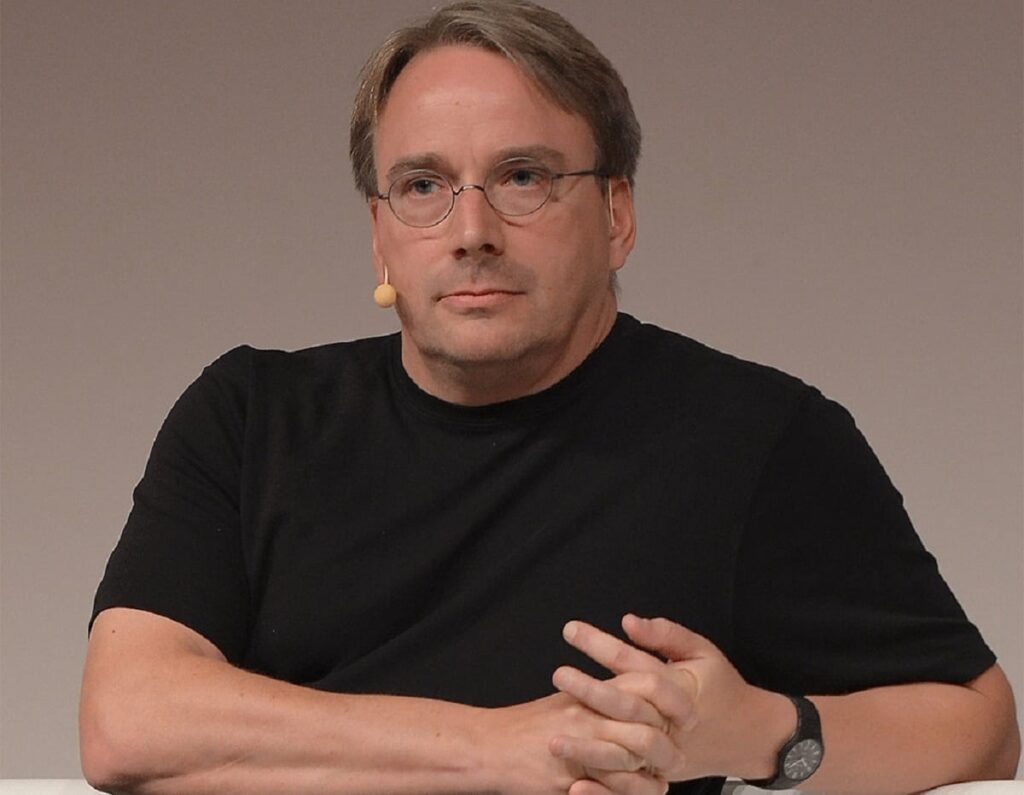
The career of Linus Torvalds spans more than 35 years, from a student hobby project to stewardship of the most important open-source project in the world.
Year-wise Career Progress
The table below summarizes the key milestones of his career by year and age.
| Year | Age | Position | Key Achievement |
|---|---|---|---|
| 1991 | 21 | Student, University of Helsinki | Announced Linux on Usenet (25 August) and released version 0.01 (September) |
| 1992 | 22 | Student / Linux maintainer | Relicensed Linux under the GNU GPL |
| 1994 | 24 | Linux lead developer | Released Linux 1.0 |
| 1996 | 26 | Linux lead developer | Released Linux 2.0; Tux the penguin chosen as mascot |
| 1997 | 27 | Engineer, Transmeta Corp. | Moved to Santa Clara, California |
| 1999 | 29 | Engineer, Transmeta | Received stock options from Red Hat and VA Linux; both IPOs boosted his wealth |
| 2003 | 33 | Fellow, Open Source Development Labs (OSDL) | Left Transmeta to work full-time on Linux |
| 2005 | 35 | OSDL Fellow | Created Git in about 10 days; handed maintenance to Junio Hamano |
| 2007 | 37 | Linux Foundation Fellow | OSDL merged into the newly formed Linux Foundation |
| 2010 | 40 | Linux Foundation Fellow | Became a US citizen |
| 2011 | 41 | Linux Foundation Fellow | Released Linux 3.0; co-created Subsurface dive log software |
| 2012 | 42 | Linux Foundation Fellow | Won the Millennium Technology Prize |
| 2015 | 45 | Linux Foundation Fellow | Released Linux 4.0 |
| 2018 | 48 | Linux Foundation Fellow | Took a short break, apologized for past behavior; kernel adopted a Code of Conduct |
| 2019 | 49 | Linux Foundation Fellow | Released Linux 5.0 |
| 2022 | 52 | Linux Foundation Fellow | Released Linux 6.0; Rust support merged into the kernel |
| 2026 | 56 | Linux Foundation Fellow | Released Linux 6.19, 7.0, 7.1, 7.2 and 7.3; endorsed AI coding tools in kernel work |
Phase 1: The Student Hacker Years (1988–1996)
This phase turned a personal experiment into a global movement.
- Wrote a terminal emulator on his 386 PC that gradually grew into an operating system kernel.
- Posted his famous “just a hobby, won’t be big and professional” announcement on the comp.os.minix newsgroup in August 1991.
- Switched Linux to the GPL in 1992, allowing anyone to use, modify and share it.
- Released Linux 1.0 in 1994 and Linux 2.0 in 1996, with support for multiple architectures and multiprocessing.
Phase 2: The Transmeta Years (1997–2003)
Torvalds moved to Silicon Valley but kept Linux as his central project.
- Worked on the Crusoe processor’s code-morphing software at Transmeta.
- Received stock options from Red Hat and VA Linux, whose 1999 IPOs created most of his personal wealth.
- Published Just for Fun in 2001 with journalist David Diamond.
- Oversaw the 2.2 and 2.4 kernel series as Linux took over the server market.
Phase 3: Full-time Linux Steward (2003–2018)
Torvalds became a paid, independent steward of Linux, funded by industry through OSDL and then the Linux Foundation.
- Created Git in 2005 after the kernel lost access to the proprietary BitKeeper tool.
- Introduced the time-based release cycle (two-week merge window, about seven weekly release candidates).
- Oversaw Linux’s rise inside Android, cloud computing and all of the world’s top 500 supercomputers.
- Received the Millennium Technology Prize (2012) and induction into the Internet Hall of Fame (2012).
Phase 4: The Mature Leader (2018–Present)
After 2018, Torvalds softened his communication style and focused on long-term health of the project.
- Supported the kernel Code of Conduct and a more welcoming community culture.
- Approved Rust as a second language for kernel development in 2022.
- Moved Linux through the 6.x series and into the 7.x era in 2026.
- Backed a formal continuity process for future kernel leadership.
Major Achievements & Awards
Torvalds is one of the most decorated software engineers alive, with honors from technology, science and engineering organizations worldwide.
| Year | Award | Organization | Significance |
|---|---|---|---|
| 1998 | Pioneer Award | Electronic Frontier Foundation | Recognized early impact of Linux |
| 1999 | Honorary Doctorate | Stockholm University | First major academic honor |
| 2000 | Lovelace Medal | British Computer Society | Top UK computing honor |
| 2000 | Honorary Doctorate | University of Helsinki | Honored by his alma mater |
| 2001 | Takeda Award (shared) | Takeda Foundation, Japan | Social and economic well-being through technology |
| 2004 | Time 100 | Time magazine | Named among the world’s most influential people |
| 2005 | Vollum Award | Reed College | Distinguished accomplishment in science and technology |
| 2006 | Time “Revolutionary Heroes” | Time Europe | Listed among 60 years of European heroes |
| 2008 | Fellow | Computer History Museum | Lifetime recognition in computing history |
| 2010 | C&C Prize | NEC C&C Foundation | Contributions to information technology |
| 2012 | Millennium Technology Prize | Technology Academy Finland | One of the world’s largest technology prizes |
| 2012 | Internet Hall of Fame | Internet Society | Inducted as an Innovator |
| 2014 | Computer Pioneer Award | IEEE Computer Society | Pioneering work on open-source operating systems |
| 2018 | Masaru Ibuka Consumer Electronics Award | IEEE | Impact of Linux on consumer electronics |
An asteroid, 9793 Torvalds, is also named after him.
Linus Torvalds Net Worth Without Charity
Torvalds is not known for large, publicized charitable donations, and he has never announced a foundation or pledge. His biggest “gift” is Linux itself, which he released free of charge and which arguably created trillions of dollars of value for others. Because his private donations are undisclosed and appear modest relative to his assets,
Linus Torvalds net worth without charity is estimated at about $50–52 million, or roughly ₹440–460 crore. In other words, Linus Torvalds net worth in rupees barely changes whether you count donations or not. If he had commercialized Linux in the 1990s instead of open-sourcing it, many analysts believe his fortune could have reached billions.
Investment Philosophy & Financial Principles
Torvalds rarely speaks about money, but his public comments and lifestyle suggest a few clear principles:
- Enough is enough: He has said money stops mattering once your basic needs and comfort are secured.
- Work for enjoyment: Fun and meaningful work come first; income follows.
- Stay independent: He prefers a neutral, salaried role at the Linux Foundation over working for any single tech company.
- Avoid flashy spending: He lives a comfortable family life in Oregon without a celebrity lifestyle.
- Long-term thinking: His wealth largely came from holding early stock grants and steady income over decades.
- Value over valuation: He measures success by how many people use and improve his software, not by a balance sheet.
Administrative Positions & Organizational Leadership
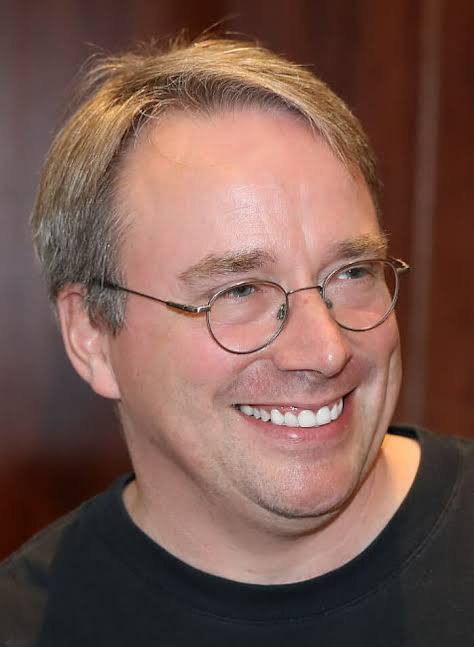
Although Torvalds has never been a CEO, he holds one of the most influential leadership roles in technology as final decision-maker for the Linux kernel.
| Period | Position | Organization | Role |
|---|---|---|---|
| 1991–present | Creator and lead maintainer | Linux kernel project | Final merge authority for the mainline kernel |
| 1993–1996 | Teaching / research assistant | University of Helsinki | Academic support while developing Linux |
| 1997–2003 | Software engineer | Transmeta Corporation | Worked on processor software |
| 2003–2007 | Fellow | Open Source Development Labs (OSDL) | Paid to work full-time on Linux |
| 2005 | Creator and initial maintainer | Git | Built Git, then handed it to Junio Hamano |
| 2007–present | Fellow | The Linux Foundation | Independent, industry-funded kernel leadership |
| 2011–present | Co-creator | Subsurface dive log | Hobby open-source project for scuba divers |
He has now led the Linux kernel for about 35 years, since 1991, one of the longest leadership tenures of any major software project.
Career Philosophy
Torvalds’ best-known motto is: “Talk is cheap. Show me the code.” His leadership rests on five pillars:
- Technical merit wins: Decisions are based on what works, not on politics or ideology.
- Never break user space: Changes must not break programs that already work for users.
- Trust a network of maintainers: He relies on about 100+ subsystem maintainers rather than micromanaging.
- Release early, release regularly: A predictable roughly nine-to-ten-week release cycle keeps the project healthy.
- Pragmatism over purity: He supports whatever tools (Git, Rust, AI assistants) actually help developers.
Mentorship Style
Torvalds does not mentor people one-on-one in a formal way, but his style influences thousands of contributors.
| Aspect | His Approach | Impact on Developers |
|---|---|---|
| Communication | Direct and honest; softer since 2018 | Developers know exactly where they stand |
| Delegation | Trusts subsystem maintainers | Builds a deep bench of future leaders |
| Code review | Focuses on clarity and correctness | Raises code quality across the kernel |
| Learning | Encourages learning by doing | New contributors start with small patches |
| Accountability | Maintainers own their subsystems | Clear responsibility and fast fixes |
| Openness | All discussion on public mailing lists | Transparent decisions anyone can study |
Recent Developments (2025–2026)
The last two years have been among the busiest in Linux history, with a new major version series, record contribution numbers and a heated debate about AI.
- Succession planning: In January 2026, the kernel added documentation describing how the community would choose new leadership if Torvalds steps away. It describes a process rather than naming an heir, and Torvalds has said he has no plans to retire.
- Linux 6.19 and the move to 7.0: In February 2026, Torvalds released Linux 6.19 and confirmed the next version would be 7.0, joking that he was running out of fingers and toes for counting. Linux 7.0 arrived in spring 2026 with stronger Rust support.
- The AI debate: In May 2026 he complained that AI-generated bug reports and late fixes were overloading the kernel’s mailing lists. In July 2026 he declared that Linux is “not an anti-AI project,” saying developers who object to others using AI tools are free to fork the project.
- Linux 7.2 and 7.3: Torvalds described the large number of AI-assisted fixes as “the new normal.” Linux 7.3, released on 18 October 2026, set records for non-merge commits, total contributing developers and first-time contributors.
- Linux 7.4: Development of Linux 7.4 is under way in late 2026.
Current Role
| Position | Organization | Status | Focus Area |
|---|---|---|---|
| Lead maintainer of the Linux kernel | Linux kernel project | Active | Merging code, managing release cycles (7.x series) |
| Linux Foundation Fellow | The Linux Foundation | Active | Independent, vendor-neutral kernel leadership |
| Hobby developer | Subsurface | Occasional | Dive-log software |
| Public speaker | Open Source Summit and similar events | Occasional | Fireside chats on kernel, AI and community |
Detailed Biography
This section brings the full story of Linus Torvalds together, from childhood in Helsinki to his role in the 2026 AI-driven era of software.
Early Life
Linus Benedict Torvalds was born on 28 December 1969 in Helsinki, so the answer to Linus Torvalds birthday is 28 December, and Linus Torvalds age is 56 in 2026. He grew up in a Swedish-speaking household of journalists. His maternal grandfather, a statistics professor, owned a Commodore VIC-20, and young Linus began writing programs on it in BASIC and then machine code. He later saved up for a Sinclair QL and modified its operating system to suit his needs, a sign of the tinkerer he would become.
Education
Torvalds enrolled at the University of Helsinki in 1988 to study computer science. His studies were interrupted by a year of military service in the Finnish Navy, where he became a second lieutenant. Back at university in 1991, he bought an Intel 386 PC and, frustrated with the limits of the teaching OS MINIX, began writing his own kernel. He completed his Master of Science in 1996, with a thesis on making Linux portable across hardware architectures.
Career Milestones
After Linux took off, Torvalds moved to California in 1997 to join Transmeta. In 1999, Red Hat and VA Linux gave him stock options as thanks for creating Linux; their IPOs during the dot-com boom became the foundation of his personal fortune and the main reason Linus Torvalds net worth in rupees sits in the hundreds of crores today.
In 2003 he left Transmeta to work on Linux full-time at OSDL, which became the Linux Foundation in 2007. His Linux Foundation compensation has been reported in public tax filings at more than $1 million per year in recent years, making it a steady pillar of his income.
Landmark Projects
- Linux kernel (1991–present): Powers Android, most web servers, cloud platforms, embedded devices and all of the world’s top 500 supercomputers.
- Git (2005): Now the standard version control system for software development worldwide, underpinning platforms like GitHub and GitLab.
- Subsurface (2011–present): An open-source dive log program, born from his love of scuba diving.
- Guitar pedals: In recent years he has built his own guitar effects pedals as a hardware hobby.
Recent Developments
In 2026, Torvalds guided Linux through the 6.19 release and into the 7.x era. He has embraced AI-assisted development in a pragmatic way, while pushing back on low-quality, machine-generated noise. The kernel also formalized a continuity process for future leadership, ensuring the project can outlive any one person, though Torvalds remains firmly in charge.
Lessons & Inspiration
- Start small: Linux began as “just a hobby,” proof that big things can grow from modest experiments.
- Share freely: Open-sourcing Linux created far more value for the world than selling it would have.
- Build communities: Torvalds’ greatest skill may be coordinating thousands of strangers.
- Grow as a person: His 2018 apology showed that even legends can change how they lead.
- Adapt to new tools: From Git to Rust to AI, he adopts whatever helps get the job done.
Conclusion
Linus Torvalds is proof that wealth and impact are not the same thing. Linus Torvalds net worth of about $50 million, or roughly ₹440 crore, is modest compared with tech billionaires, yet his code runs inside billions of devices and supports a large share of the global digital economy. When people compare Linus Torvalds net worth in rupees to the value of the industries built on Linux and Git,
the gap is enormous, and that is exactly the choice he made by keeping his work open. His real wealth is a 35-year legacy, a project with thousands of contributors in 2026, a stable family life with his wife Tove and three daughters, and the freedom to keep working “just for fun.”
Frequently Asked Questions (FAQ)
1. What is Linus Torvalds net worth in rupees in 2026?
Linus Torvalds net worth in rupees is estimated at about ₹440 crore in 2026, based on a commonly cited estimate of around $50 million USD. This is an estimate, not an officially disclosed figure.
2. What is Linus Torvalds net worth without charity?
His net worth without charity is estimated at about $50–52 million (roughly ₹440–460 crore). His private donations are not publicly disclosed, so the difference is small.
3. Is Linus Torvalds married?
Yes. Linus Torvalds’ wife is Tove Torvalds, a former six-time Finnish national karate champion. They married in 1993.
4. Does Linus Torvalds have a son?
No. Linus Torvalds has three daughters: Patricia (born 1996), Daniela (born 1998) and Celeste (born 2000).
5. What is Linus Torvalds’ current position?
He is the creator and lead maintainer of the Linux kernel and a Fellow at the Linux Foundation, overseeing the Linux 7.x release series in 2026.
6. What are Linus Torvalds’ major achievements?
He created Linux (1991) and Git (2005), and has received the Millennium Technology Prize, the Lovelace Medal, the EFF Pioneer Award, IEEE awards and induction into the Internet Hall of Fame.
7. How long has Linus Torvalds led the Linux project?
He has led the Linux kernel for about 35 years, since he released it in 1991.
8. What is Linus Torvalds’ educational background?
He holds a Master of Science in Computer Science from the University of Helsinki (1996), plus honorary doctorates from Stockholm University and the University of Helsinki.
9. What is Linus Torvalds’ religion?
He is not religious and has described himself as uninterested in religion.
10. What are Linus Torvalds’ hobbies and interests?
He enjoys scuba diving (and co-created the Subsurface dive log), reading, spending time with family and building electronics such as guitar effects pedals.
11. What is Linus Torvalds’ philosophy on wealth?
He believes money matters only up to a point. Once comfortable, he prioritizes enjoyable work and community impact over getting richer.
12. Has Linus Torvalds made charitable donations?
He has no publicized foundation or major pledges. His largest contribution to society is releasing Linux and Git as free, open-source software.
13. What is Linus Torvalds’ age and birthday?
Linus Torvalds was born on 28 December 1969 and is 56 years old in 2026. He turns 57 on 28 December 2026.
14. How did Linus Torvalds make his money?
Mainly through Red Hat and VA Linux stock options received in 1999, his long-term salary as a Linux Foundation Fellow, and royalties from his book Just for Fun.
Disclaimer
The net worth figures in this article are estimates based on publicly available reports and media sources as of November 2026. Linus Torvalds has not officially disclosed his personal finances. Rupee conversions are approximate and depend on the USD to INR exchange rate at the time of reading. Physical details such as height and weight are unverified public estimates. This article is for informational purposes only and should not be considered financial advice.
Also read https://yesitfirm.com/sylvester-stallone-net-worth/